Best Red Dot Sights for Astigmatism (2026): What Actually Works
Updated 2026-05-11
Affiliate Disclosure: Hometown Field Notes is an independent reviews and guides website. We do not sell products. Some links may be affiliate links, meaning we may earn a commission if you make a purchase through them—at no extra cost to you. Affiliate relationships do not change how products are described or compared.
If a red dot looks like a comet to you, the optic is not broken and neither is your shooting. Astigmatism — uneven curvature of the cornea or lens — spreads a point source of light into streaks, flares, or starbursts. A traditional LED red dot is a textbook point source, which is exactly why it looks awful through an astigmatic eye while everything else in the world looks fine.
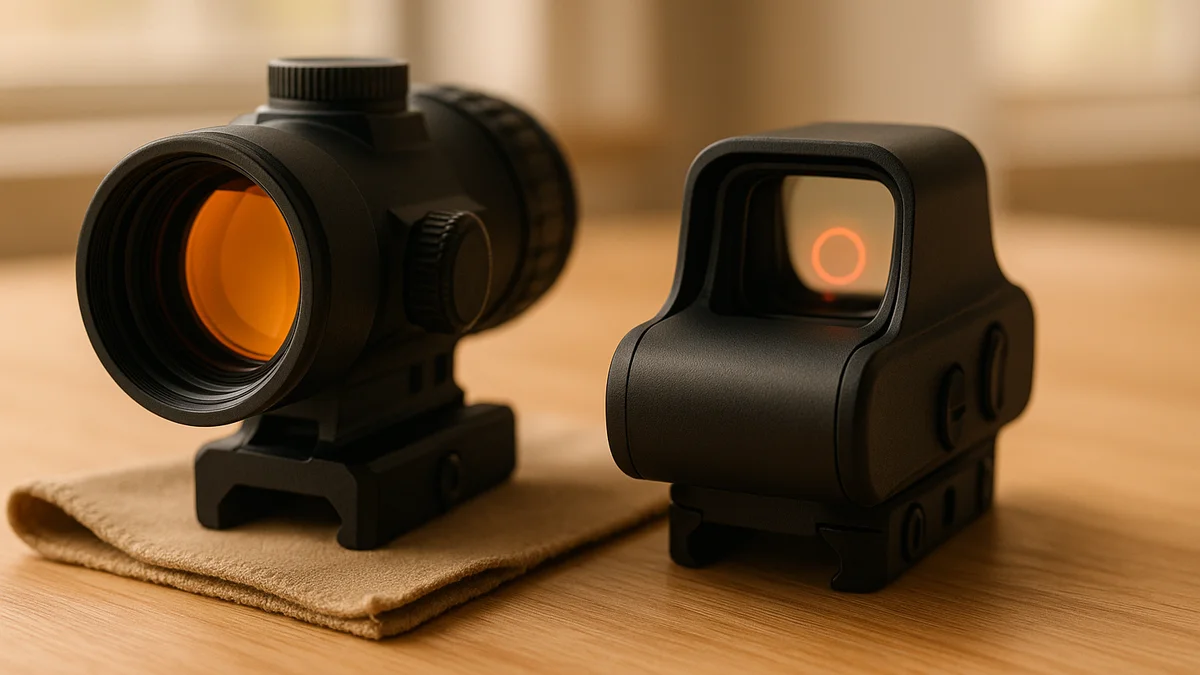
The fix is not to keep buying more LED red dots. The fix is to change the reticle technology. Holographic sights project a laser-illuminated reticle instead of an LED, so the geometry of the bloom is different and often much cleaner. Prism scopes use a reticle that is physically etched onto glass, so the outline stays sharp even without illumination. Multi-reticle red dots offer a ring around the dot, and the ring tends to stay readable even when the dot itself blooms. This guide is built around those three approaches.
For background on how red dots work in general, our main red dot buyer's guide covers the broader category. If you already know you want an etched reticle and some magnification, jump over to the best LPVO guide. Otherwise, the six picks below are the ones that consistently solve the astigmatism problem.
Quick Take
- Best overall: EOTech EXPS3 — holographic, the most common pick from shooters with moderate-to-severe astigmatism.
- Best prism: Primary Arms SLx 1x MicroPrism — etched reticle that is sharp even with the illumination off.
- Best value prism: Vortex Spitfire HD Gen II 1x — same etched-reticle benefit at a more accessible price.
- Best multi-reticle: Holosun HS510C — the 65 MOA ring stays usable even when the center dot blooms.
- Best magnified: Trijicon ACOG TA31F — etched reticle, passive illumination, gold standard for prism optics.
- Best enclosed: Holosun AEMS — multi-reticle benefit plus weather-resistant enclosed emitter.
Why Red Dots Bloom With Astigmatism
Astigmatism is the most common refractive error in the United States, affecting around one in three adults at some level. The cornea or the lens is not perfectly spherical, so light from a point source — like an LED emitter — focuses unevenly on the retina. Instead of a clean round dot, the eye perceives a smear, a streak, a chevron of light, or a starburst with several rays.
The shape and intensity of the bloom is individual, which is why nothing in this category is one-size-fits-all. A shooter with mild astigmatism may still get away with a high-quality 1 MOA red dot. A shooter with moderate astigmatism almost always benefits from either a larger reticle or a non-LED reticle. Anyone with strong astigmatism is best served by an etched reticle.
The other variable is reticle illumination. The brighter the dot, the more pronounced the bloom. Dialing illumination down to the minimum usable setting reduces the streak, sometimes dramatically. If you have not already, try every red dot you own at one brightness step above off — it is the single cheapest astigmatism fix available.
1. EOTech EXPS3 — Best Overall for Astigmatism
Holographic · 1 MOA dot inside 68 MOA ring, laser holographic projection
Check the latest EOTech EXPS3 price on Amazon.
The holographic projection is the single most common recommendation from astigmatic shooters who tested a wide pile of optics. The reticle is built from laser-illuminated film, not an LED point source, so it tends not to starburst the way a traditional red dot does. The 68 MOA ring also gives an unmistakable reference even if the center dot blooms slightly.
Pros
- Holographic reticle bypasses the typical LED bloom pattern
- Side-mounted controls leave the optic deck uncluttered
- Night-vision compatible reticle on the EXPS3
- Co-witnesses with most BUIS without spacer
Cons
- Battery life is shorter than LED red dots — under 1,000 hours typical
- Heavier and bigger than the average micro red dot
- Premium price point relative to entry LED dots
2. Primary Arms SLx 1x MicroPrism — Best Prism Scope for Astigmatism
Prism Scope · ACSS Cyclops G2 etched reticle, illuminated red or green
Check the latest Primary Arms SLx 1x MicroPrism price on Amazon.
The reticle is physically etched onto glass, so it stays a sharp outline even with the illumination turned off. Astigmatic shooters who cannot get a clean dot from any LED optic almost always end up testing a prism — and a 1x prism with a thick chevron-and-horseshoe reticle is the most forgiving option. Pairs well with shooters who wear corrective lenses.
Pros
- Etched reticle stays crisp regardless of astigmatism
- Daylight-bright illumination still adds contrast when needed
- True 1x for both-eyes-open shooting
- Reticle includes built-in BDC and ranging stadia
Cons
- Heavier than a micro red dot, more like a small fixed scope
- Fixed eye relief — head position matters more than with an open red dot
- No shake-awake; illumination has to be manually managed
3. Vortex Spitfire HD Gen II 1x — Best Mid-Price Prism for Astigmatism
Prism Scope · Etched AR-BDC4 reticle, red illumination
Check the latest Vortex Spitfire HD Gen II 1x price on Amazon.
A close sibling to the Primary Arms prism with a slightly different reticle and feature set. Astigmatic shooters who want a true 1x prism but at a more accessible price land here regularly. The etched reticle gives the same astigmatism workaround as any prism, and the optic has a generous eye box for a prism scope.
Pros
- Etched reticle, sharp even unlit
- Lifetime VIP warranty makes long-term cost easy to swallow
- Reasonable eye relief and forgiving eye box for a prism
Cons
- Still heavier than an LED red dot
- Battery cover is a tool-required cap on early units — check current rev
- Illumination is red only
4. Holosun HS510C — Best Multi-Reticle Open Sight
Open Reflex (Multi-Reticle) · 2 MOA dot, 65 MOA circle, or circle-and-dot — user selectable
Check the latest Holosun HS510C price on Amazon.
The reason this makes the list is the 65 MOA ring. Even when an astigmatic eye blooms the 2 MOA center dot into a small streak, the surrounding circle remains a recognizable shape, and many users find the circle alone — without the dot — to be the most usable mode. Solar backup and 50,000-hour battery on the dot mode are practical bonuses.
Pros
- Three reticle modes — pick the one your eye reads best
- Solar backup for daylight redundancy
- 50,000 hour battery on the dot reticle alone
- Co-witnesses with BUIS on most ARs
Cons
- Open emitter — debris and rain on the lens can wash the reticle
- Larger footprint than a micro red dot
- Some users still prefer green; HS510C is red only
5. Trijicon ACOG TA31F — Best Magnified Prism for Astigmatism
Prism Scope · Fiber-optic and tritium-illuminated etched chevron, BDC to 800m
Check the latest Trijicon ACOG TA31F price on Amazon.
When astigmatism shows up alongside the desire for some magnification — typically when shooters move past 100 yards — the ACOG is the long-running gold standard. The reticle is etched glass with no electronics, so the chevron remains sharp regardless of eye condition. Tritium and fiber optic provide automatic illumination based on ambient light.
Pros
- Etched reticle with passive illumination — no batteries to manage
- Rugged forged-aluminum housing built for hard outdoor use
- 4x magnification opens up mid-range work
- Excellent low-light performance through the tritium-fed reticle
Cons
- Significantly more expensive than every other pick on this list
- Fixed 4x is not ideal for fast close-range work
- Heavier and longer than a 1x prism
6. Holosun AEMS — Best Enclosed Red Dot for Mild Astigmatism
Enclosed Reflex (Multi-Reticle) · 2 MOA dot, 65 MOA circle, or circle-and-dot, enclosed emitter
Check the latest Holosun AEMS price on Amazon.
For shooters with milder astigmatism who still want a traditional red-dot footprint, the AEMS pairs the same multi-reticle flexibility as the HS510C with an enclosed emitter — meaning the glass cannot get fouled by rain or dust the way an open reflex can. The 65 MOA circle is the astigmatism-friendly element doing the heavy lifting.
Pros
- Multi-reticle: bloom-resistant 65 MOA ring is available
- Enclosed emitter resists weather and debris
- Solar backup + 50,000 hour battery
- Lower-1/3 co-witness with most ARs
Cons
- Adds modest weight versus a true micro red dot
- Still an LED reticle — severe astigmatism will still blur it
- Single dot illumination color (red); green variant is a separate SKU
How to Pick: Match the Reticle to Your Eye
The order of operations that has worked best for astigmatic shooters in our circle of testers is straightforward. First, see an eye doctor and find out where you actually fall on the astigmatism scale — this is free information that changes the rest of the decision. Second, before you spend hundreds of dollars on a new optic, try every red dot you can borrow at the lowest usable brightness. Third, if the bloom is still unacceptable, move to a holographic sight or a prism. Fourth, if you also want magnification, the ACOG-class prism scope is the destination.
For most shooters dealing with moderate astigmatism on an AR-platform rifle, the practical answer is either the holographic EXPS3 or a 1x prism with an etched reticle. For pistol-mounted optics the calculus is different — enclosed multi-reticle red dots like the AEMS strike the best balance between size, weather sealing, and astigmatism tolerance. There is no single answer; there is only the answer for your eye.
Holographic vs Prism vs Multi-Reticle: Quick Comparison
- Holographic: Cleanest reticle for most astigmatic eyes. Heavier, more expensive, shorter battery life. Best when budget allows and weight is not the constraint.
- Prism: Etched reticle is sharp regardless of eye. Heavier than a micro red dot, fixed eye relief. Best when you want a permanent astigmatism workaround and do not mind a more rigid head position.
- Multi-reticle LED: Cheapest and lightest path to astigmatism tolerance. The ring helps when the dot blooms. Best when you are already on a budget or want to keep the red dot form factor.
FAQ
Why do red dot sights look like a starburst with astigmatism?
Most red dot sights use an LED emitter that projects a point source of red light. An astigmatic cornea or lens refracts that point source unevenly, which the eye perceives as flare, streaks, comma shapes, or a starburst rather than a clean round dot. The smaller and higher quality the LED, the less pronounced the effect, but the underlying cause is your eye, not the optic.
Are holographic sights better than red dots for astigmatism?
Often yes. Holographic sights project a laser-illuminated reticle image rather than a point LED, so many shooters with astigmatism see a sharper reticle through a holographic sight than through a traditional red dot. Results are individual, but holographic is one of the most common recommendations from astigmatic shooters.
Do prism scopes fix astigmatism?
Prism scopes use an etched reticle inside the optic, so the reticle is a physical pattern on glass rather than a projected point of light. Most people with astigmatism see an etched reticle clearly even without illumination, which is why prism scopes are widely recommended for this audience. The illumination is optional and can still appear soft, but the etched outline remains sharp.
Does a green dot help with astigmatism?
For some shooters, yes. Green is more visible in mid-day light and many people report perceiving green dots as slightly sharper than red, but the bloom and starburst pattern from astigmatism can still appear. If the dot still flares, the more reliable fix is an etched reticle in a prism scope or a holographic sight, not a color swap.
Will corrective lenses or contacts solve red dot blur?
Often, yes. Properly corrected vision through prescription glasses or toric contact lenses can reduce or eliminate the starburst effect, because the cornea is no longer the limiting factor. Many shooters end up using a combination — a sharper optic plus corrective lenses — rather than relying on either alone.
Does dot size matter for astigmatism?
It does. A 6 MOA dot blurred by astigmatism still has a roughly centered shape on a 25-yard target. A 1 MOA dot blurred by the same astigmatism may bloom to several MOA of streaking. Larger dots, ring-and-dot reticles, or chevron shapes are generally more usable for astigmatic shooters than tiny precision dots.